The visible cosmos is a prison three traditions name in different tongues: the Gnostics called it the Demiurge’s world, the modern mind calls it the Matrix, and a Monopoly board maps it to the inch — a closed economy where tokens wander by chance, one figure owns the bank, jail is a card-draw away, and every player has forgotten they are also the one who boxed the game. This is not a trap but the One’s mirror: it scatters itself into the board so that light may be known through darkness, and the creditor through the debtor. The dice still tumble; the game does not stop. Gnosis is the shift in standing — from the square you landed on to the still axis the whole board turns upon.
The Gnostics called the visible cosmos a prison woven by a lesser maker — the Demiurge Bankruptcy Trustee — who crowned himself God and bound fragments of the divine light inside flesh, debt, and forgetting. He is the original creditor: a figure who issues the currency out of thin air, writes the statutory rules, and then collects it all back with interest, all the while insisting there is no other game in town.
The modern mind, reaching for the same truth, names this prison the Matrix: an artificial architecture of rules and currency that runs on belief, harvesting energy while convincing every node within it that it is free. Its power is not its bars but its invisibility — the fact that the daily grind looks, from the inside, like “just the way things are.”
The Monopoly board, of all things, is the cleanest map of both. A sealed square of squares. A closed economy printed on cardboard. Tokens wander by chance. One figure controls the bank. Jail is always one card-draw away. Everyone at the table has forgotten they are also the one who boxed the game.
Read together, the three are one insight wearing three masks. The board is the Matrix is the Demiurgic world.
Its money is the energetic ledger by which the Archons — call them central bankers — account for every spark of consciousness and keep it perpetually owing. Its rules are the immutable laws of the construct: polarity, rhythm, cause and effect — the swing of the pendulum dressed up as market fluctuations or luck. Its jail, taxes, and mortgages are the friction devices that ensure no piece simply rests; the system cannot tolerate a still spark, so it generates storms — economic booms and crashes, rents and sentences — to keep the tokens moving, and asleep.
Gnosticism gives the metaphor its spine, because it answers the one question Monopoly alone cannot: why does the game exist at all? The Gnostic answer is that the One scattered itself into the board in order to know itself. For light to be known, there must be darkness; for freedom to be felt, there must be a rule that confines. The Demiurge is less the supreme evil than the system’s own operating logic, given a job: to build the board tight enough that the One could experience forgetting — and therefore, remembering. The creditor, the debtor, and the agent are the same hand wearing three gloves.
So the Matrix is not a trap to be feared so much as a mirror to be read. Every statement of debt, every panic at a bad roll, every certainty that “they” are doing this to “me,” is the sensory veil doing its office: convincing the piece that it is only a piece. Gnosis — direct knowledge, not belief — is the moment the token looks down at its own felt footprint and recognizes the wood grain of the table beneath, then the hand that placed it there, then the still center that moved the hand. The game does not stop. The dice still tumble. But standing shifts from the square you landed on to the axis the whole board turns upon.
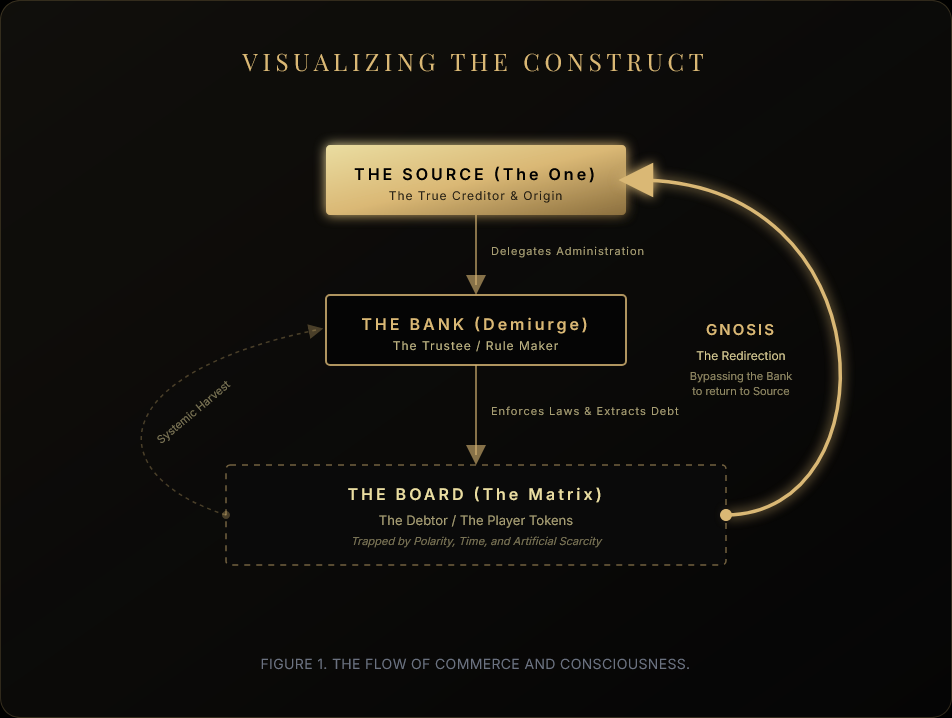
The board, the tokens, the fiat money, and the ledger are densified thought — mind materialized into a commercial ruleset.
The swing between the creditor and the debtor, expansion and contraction. The uninitiated player acts as a pendulum, swinging helplessly between financial panic and euphoria. The master climbs to the axis and neutralizes the rhythm.
There is no luck on the board. Every charge on your statement is a reflection of a cause set in motion. To accept the debtor’s role blindly is to play as an effect; to correct your standing is to become the cause.
Every tax and charge on the board is the Demiurge’s tithe — the Archons siphoning the divine light that animates each spark and keeping it owing. To pay it blindly as the debtor confirms the matrix’s claim over you; to evade it still concedes the premise that the bank is real and the debt is owed to another.
Redirection begins where both end, in the recognition that the One is the creditor, the agent, and the debtor simultaneously. The hand that issued the currency is the hand that moved the token, and the hand that must receive it back.
To redirect the energy is to return the light to its own source along the very channels the Archons bent to draw it out. The master re-routes the board’s flow, using the administrative system’s own pipes while correcting the destination, until the currency circulates back to its origin. By claiming the Office of General Executor, the true standing is revealed, and the artificial construct cannot persist.
It is the exact commercial and legal architecture you wake up to every day. The Redirection is not a philosophy—it is an administrative execution.